

The market is flooded with vendors and digital tools, DMS systems included, leaving companies facing a tough call. Some offer proven, standardized systems; others build custom solutions or lean on AI to do it. So how do you cut through all the competing opinions and pick the right fit for your business and a partner you can actually trust?
Adapt to the system, or make the system adapt to you?
Choosing a DMS usually comes down to one dilemma: go with an existing standard solution, or invest in something built to measure. Each path has real strengths and real limits.
Standard solutions
The appeal of a standard solution is typically lower upfront cost, since there’s little or no development spend involved. If it’s cloud-hosted, you also skip the cost of running and maintaining your own infrastructure, while the vendor handles security and compliance updates. The catch: standard systems expect your company to bend its workflows to fit the software. That often breeds rigidity, workarounds outside the system, and untapped potential.
Custom solutions
Fully tailored systems deliver 100% alignment with your company’s unique processes. But that freedom comes at a price, long development timelines, significant financial investment, and the risk of vendor lock-in. On top of that, every future change, upgrade, or regulatory update means more time and more cost. Advanced standard systems that allow for configuration and extension also fall into this “custom” category, and they’re often the sweet spot, the best balance of price, quality, and proven functionality.
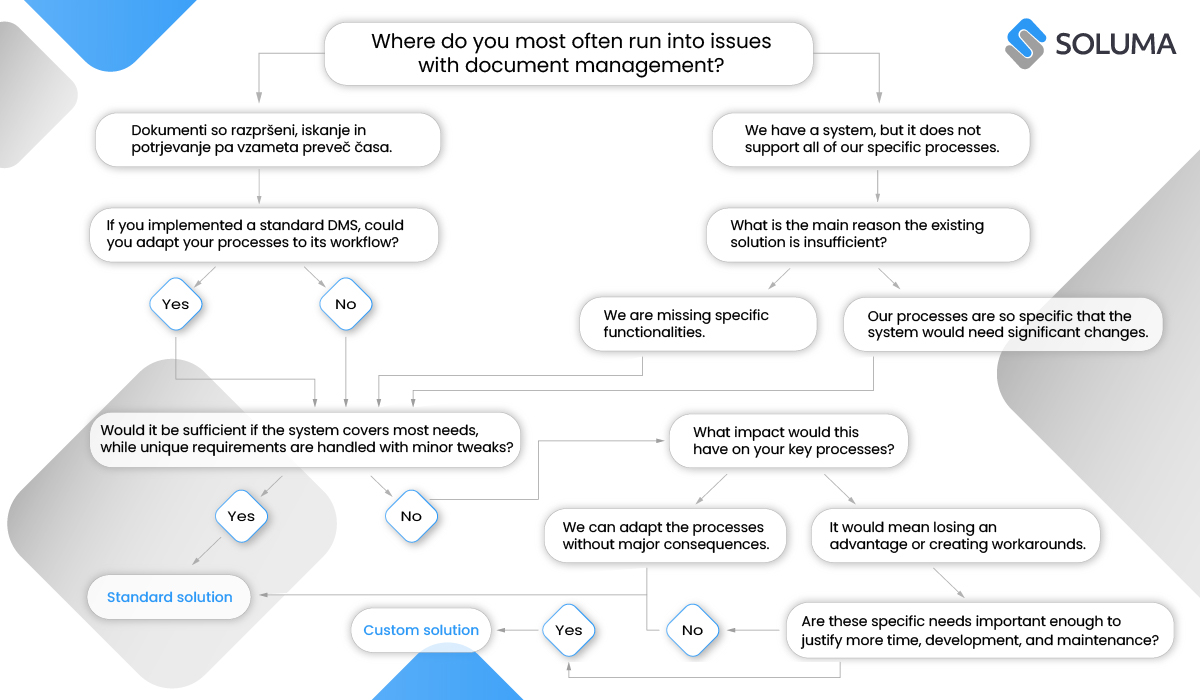
When does a company actually need a tailored solution?
It’s hard to argue that a fully custom DMS isn’t, in theory, almost always the best fit, after all, it bends completely to how the business runs. But in practice, plenty of standard, routine processes, basic bookkeeping, time tracking, certified document retention, already have proven, affordable tools built for them. Buying off-the-shelf makes total sense there, especially where regulatory compliance matters.
The real challenge appears once a company runs into workflows that are genuinely its own. Most organizations develop unique processes that cut across departments and form part of their competitive edge. In those cases, it’s unrealistic to expect a “generic” standard tool to support the business overnight. Instead, employees end up bending their work around the system, creating clumsy workarounds, manually re-entering data, and piling up unnecessary admin.
So when is it time for a tailored solution?
A company genuinely needs a custom or highly configurable platform (like M-Files) when:
- Processes are numerous and complex: your workflows span multiple departments (procurement, sales, legal, production) and need specific approval rules and traceability.
- You need to connect with existing tools: off-the-shelf solutions can’t integrate with your existing databases or specialized systems (ERP, CRM, etc.).
- You’re hitting bottlenecks you can’t solve: standard software forces staff into manual entry or parallel Excel tracking, raising the risk of errors.
- You need room to adapt and grow: your company is scaling fast or operates in a heavily regulated industry where rules and internal procedures keep shifting.
A tailored DMS doesn’t just capture these processes, it automates and simplifies them. Rather than the business bending to the software’s limits, a custom platform becomes the flexible foundation that supports your unique strategy and long-term growth.
How does automation cut manual work and boost efficiency?
A company’s success isn’t measured by how hard employees work, but by how well-optimized its processes are and how much time gets lost to unnecessary, poorly designed steps in between. Running a business on constant employee overload is never the better option. And poorly automated processes stretch out how long tasks take, costing both time and money, while opening the door to more mistakes.
Modern DMS platforms like M-Files close that gap by automating routine tasks:
- Automatic document routing: documents (incoming invoices, contracts, leave requests) are automatically routed to the right people for review or approval.
- No more manual entry: the system uses AI to recognize a document’s content and classify and index it automatically.
- Reminders and traceability: the system flags deadlines and open tasks automatically, so nothing gets stuck sitting in an inbox.
By automating repetitive tasks, employees are freed from administrative overhead. Instead of constantly “putting out fires,” they can focus on strategic work, and productivity goes up.
How do the right DMS solutions cut costs in the long run?
In today’s business world, “time is money” isn’t just a cliché, it’s a measurable financial category. Companies often fall into the trap of “false savings”: by holding back on investing in the right software to save on upfront costs, they overlook the invisible but very real ongoing cost of inefficiency.
When a company skips buying or adapting the right system, employees have to fill that gap with manual work. Instead of focusing on high-value tasks, they burn valuable time on routine admin, re-typing data, hunting for lost documents, and manually chasing approval chains. In the worst case, a company even ends up hiring extra staff just to manage the administrative chaos that a modern system would have handled automatically.
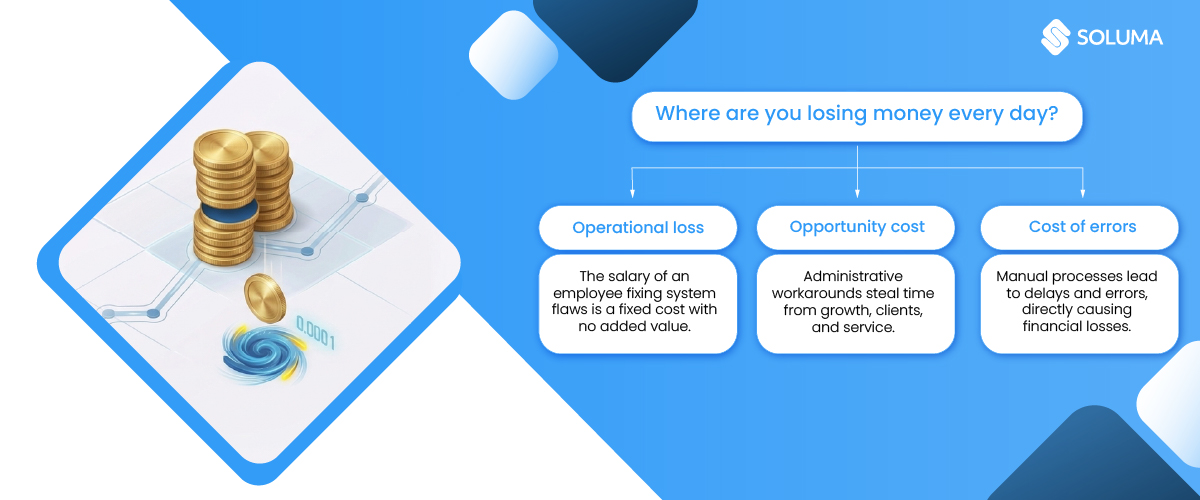
The hidden costs of short-term savings:
- The hidden cost of unoptimized processes: the salary of an employee spending most of their day working around system shortcomings is a fixed, growing cost that adds no value.
- Opportunity cost: while employees are tied up with administrative workarounds, they’re losing time they could spend winning new clients, improving service, or developing products.
- The cost of human error: manual processes inevitably lead to mistakes, from missed invoice payment deadlines to order errors, which translate directly into unexpected financial losses.
What looks like savings at first ends up, over the years, as a massive financial burden. Investing upfront in an advanced, adaptable solution might look like the pricier option at a glance. But a proper ROI analysis tells a very different story: by automating work, eliminating errors, and freeing up employees, the investment doesn’t just pay for itself relatively quickly, it sets the company up for a more stable, profitable, and cost-efficient future.
Vibe coding or a proven DMS platform, what's right for your business?
Is “vibe coding” just a passing trend, or a genuine solution for your company?
There’s been a lot of buzz lately in DMS development circles around so-called “vibe coding”, an approach where a human no longer writes code by hand but hands the whole job of building the application to AI, only steering it with plain-language instructions.
It sounds, at first glance, like the ideal, blazing-fast route to a new application, but in a serious business setting, it carries far more risk than reward. AI generates code based on patterns, not on a deep understanding of your business logic. And because this approach often involves people without technical backgrounds, it tends to quickly pile up into a tangle of unreviewable code, riddled with security holes and structural flaws.
An application built this way might run smoothly on the surface for a while. But the moment data volume spikes significantly, regulations change, or you try to connect it to other systems, that untested foundation tends to collapse. Fixing that kind of technical chaos, or rebuilding from scratch, ends up costing far more than investing in a properly engineered solution from the start.
None of this means AI is useless in programming, quite the opposite. It’s an extremely powerful tool when it works alongside an experienced developer who understands the system’s architecture and security and oversees every step. But handing development entirely over to AI without technical oversight is a risk no stable company should take. Secure operations still depend on proven, professionally supported platforms that use AI in a deliberate, controlled way.
M-Files vs. classic DMS platforms, what's the difference?
When choosing a DMS for managing documents and business processes, companies most often run into established names like Microsoft SharePoint or OpenText. While all these tools solve the storage problem, real differences emerge in how you access information, how flexible the workflows are, and what the long-term user experience looks like.
Microsoft SharePoint: a proven standard with the limits of classic folders
SharePoint is hugely popular largely because it’s often already bundled into an existing Microsoft 365 subscription. Its strengths are tight integration with Word, Excel, and Teams, and affordability for companies already living in that ecosystem.
But at its core, SharePoint still runs on a traditional folder-and-subfolder structure. Employees need to know exactly which folder a document lives in, which in practice quickly leads to duplicate files scattered across locations and confusion over which version is current.
M-Files solves this by replacing the folder structure entirely with metadata. Instead of asking where a document is, the system asks what it’s about, which client, project, or contract type it belongs to. The same document can be viewed from multiple angles in M-Files without ever being duplicated. On top of that, M-Files connects seamlessly with SharePoint and upgrades it with advanced process automation.
OpenText: a robust giant that demands serious resources
OpenText is regarded as one of the most powerful platforms in the enterprise content management (ECM) space. Its strength lies in handling massive data volumes and adapting to the largest global corporate environments with highly specific security requirements.
But that power comes at a steep price. OpenText is extremely complex to implement and maintain, requires major financial investment, and needs a dedicated team of specialists. For most mid-sized and even many larger regional companies, it’s simply too heavy, too cumbersome, and hard to financially justify.
M-Files delivers enterprise-grade capability with far greater flexibility and a lower total cost of ownership. Because adapting workflows in M-Files doesn’t require complex programming, rollout is significantly faster, and process changes can be made on the fly, without months-long development projects.
How to choose the right DMS solution in three steps
Choosing the right path is rarely a simple black-or-white answer. Every company sits at a different stage of growth, faces its own operational challenges, and has different financial and staffing resources to draw on. To avoid costly mistakes or bad investments, it pays to follow a few key guidelines.
- Be honest about your own processes. Before you even start browsing the market, ask yourself: are our workflows genuinely standard, or are they a core part of our competitive edge? Standard solutions work fine for general, routine tasks (basic invoicing, certified document retention) where the rules are set by law. Custom systems and advanced platforms become necessary once your processes span multiple departments, require specific approval rules, or create unique value for your customers.
- Look at total cost, not just the sticker price. The initial license or development cost is only the tip of the iceberg. To get the real picture, you need to estimate total costs over the next three to five years. With ground-up custom development, factor in long lead times, the high cost of every future change, and the risk of vendor lock-in. With overly rigid standard tools, don’t overlook the hidden cost of inefficiency, from lost employee hours to manual data re-entry and error correction. Flexible platforms like M-Files offer the predictable, reasonable costs of a proven standard, while still giving you the flexibility to avoid expensive redevelopment when new needs arise.
- Build for where your business is headed. Whatever you choose today needs to comfortably support your business three or five years from now. Steer clear of tools that lock you into a rigid mold or force you to build a new information silo every time something new comes up. The right solution lets you roll out gradually, start with one critical area (contract management, say) and expand the system later, stress-free.
The right choice is the one that supports your growth
Digitalizing your business isn’t just a technical project, it’s a strategic decision that directly shapes your team’s day-to-day work and your company’s bottom line. Whether you lean toward a simple standard DMS or an advanced custom platform, let clarity about your own processes be your guide. The right solution doesn’t ask your business to bend to it, it works as an invisible accelerator, cutting out manual work, reducing risk, and freeing your people to focus on what actually creates value. Choose an adaptable system and an experienced partner, and you’re not just investing in a DMS, you’re investing in a stable, profitable future for your company.